Riding With NYCC
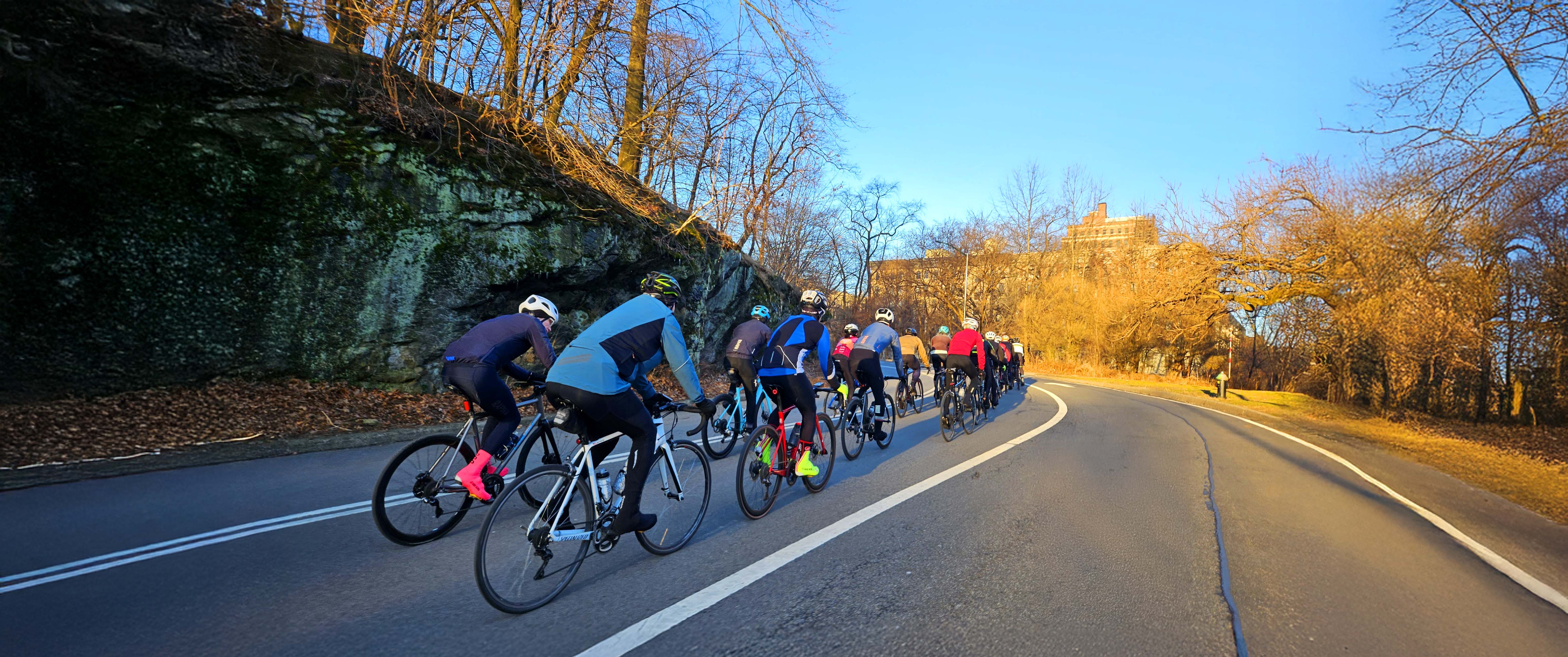
NYCC organizes group bike rides every weekend and on select weekdays for cyclists across New York City. Popular destinations include Westchester, Connecticut, Long Island, and routes across the Hudson to Bergen and Rockland counties. With rides organized by pace and distance, cyclists of all experience levels can find a ride that fits their goals.
Choosing the Best Bike Ride
Ride Level: A, B, C
Indicate the expected skill set and typical max ride length, stop frequency, vertical gain, max hill grade, and predominant terrain.
Cruising Speed:
This is the target speed for a flat road in the absence of wind. This is not the average speed, which is generally 3MPH lower than the cruising speed.
Note: NYCC classifies rides by cruising speed, not average speed.

A-Level
Skill Set:
Tight, straight, rotating pace lines; completely self-sufficient
Length:
65–100+ miles
Stop Frequency:
35–40 miles/stop
Terrain:
Average around 1000 feet each 10 miles or more, could include steep grades
B-Level
Skill Set:
Tight straight-line groups
Length:
40–80+ miles
Stop Frequency:
10–20 miles/stop
Terrain:
Average 500–700 feet every 10 miles, could include some steep grades
C-Level
Skill Set:
New club members; less experienced members; and members looking for a more relaxed ride
Length:
35–60 miles
Stop Frequency:
10–15 miles/stop
Terrain:
Typically, gentle but may have a steep hill or two. Average 500700 feet every 10 miles, could include some steep grades
A-Level
B-Level
C-Level
Skill Set:
Tight, straight, rotating pace lines; completely self-sufficient
Skill Set:
Tight straight-line groups
Skill Set:
New club members; less experienced members; and members looking for a more relaxed ride
Length:
65–100+ miles
Length:
40–80+ miles
Length:
35–60 miles
Stop Frequency:
35–40 miles/stop
Stop Frequency:
10–20 miles/stop
Stop Frequency:
10–15 miles/stop
Terrain:
Average around 600 - 800 feet each 10 miles or more, could include steep grades
Terrain:
Average 500–700 feet every 10 miles, could include some steep grades
Terrain:
Typically, gentle but may have a steep hill or two. Average 500-700 feet every 10 miles, could include some steep grades
Note: Above are general guidelines for road rides.
Gravel rides will be listed by level.
Ride leaders have the discretion to plan a ride that varies from these guidelines and will indicate that in their ride description. Review the ride listing to decide what is best.
Typical Ride Groupings
The pace of our rides typically falls into the below ranges:
A level cruising speed between 19mph to 22mph; B level between 15mph to 18mph
C level in between 12mph to 14mph
Note: While speed isn’t the only factor that determines your ride group, group riding skills, experience, and terrain also matter. Your leaders will help you find the group that’s the right fit based on comfort, communication, and riding style.
It is my first ride, what should I do?
Be conservative. Choose a ride easier and shorter than you think you can ultimately handle. You will not enjoy struggling to keep up with a ride that is too fast for you, nor will the group enjoy waiting for you.
Unsure which ride to try?
Try a C ride to start.
If a ride looks interesting but you are still not sure, reach out to the ride's leaders to introduce yourself and ask some specific questions. Our leaders are happy to answer your questions and provide you some guidance. Everyone wants you to enjoy your experience on a club ride.
Another option is to complete a self-test in Central or Prospect Park.
And use self-assessment chart to determine the pace that best suits you.
Equipment Requirements
A Level
Road bikes are generally expected; riders with any other bike configuration should check with the ride leaders. No aerobars (whether or not in use).
B&C Level
Your bike should be suitable for road riding and is generally expected to have smooth to lightly treaded tires.
Weight is important; a lighter bike is easier to ride up hills and much easier to carry up and down subway or train station stairs. (It is generally a good idea to remove unnecessary accessories and equipment from your bike).
Gravel Rides
You must use either a gravel or cyclocross bike. Gravel rides will include a significant amount of unpaved roads and trails. Depending on brake and fork clearances, one can often convert a road bike into a gravel bike simply by mounting fatter tires and installing a cassette with a larger low-gear cog.
Pre-ride Inspection Guidance
Conduct a thorough pre-ride bike inspection to confirm the overall mechanical functionality of your bike. For each ride bring your helmet, protective eyewear, adequate water/food, appropriate weather-specific clothing (including items for potential adverse weather), and repair tools (two spare tubes, pump/compressed air, bike multi-tool, tire changing tools).
If there is a mechanical problem that cannot be fixed on the road, you must be prepared to find a way home. Pedal-assist E-bikes are permitted on C and B rides at a listed pace of 16 m.p.h. or less and on faster B rides at the leader’s discretion. At present, E-bikes will not be permitted on A rides.
Participants in SIG rides will not be permitted to use E-bikes.
Pacelines
A paceline is a string of riders following closely behind one another and benefiting from drafting. The higher the speed, the more the paceline shelters riders from the wind and resulting in faster average speeds. NYCC rides at the A level ride in a paceline. B and C ride leaders have the discretion to indicate in the ride details that paceline skills are required if they would like to paceline during the ride. Visit our detailed
Paceline guide to learn more.
Drop/No-Drop Policy
All C and many B rides have a default policy of No-Drop (never leaving a rider behind on their own). This helps to encourage new riders or those not familiar with the area and route to join with the confidence that they will not be left to fend for themselves. The ride leaders and other riders will assist with resolving minor mechanical issues that might happen during a ride. B ride leaders have the option to follow a drop policy for the ride, provided that is stated in the details of the ride at the time it is posted.
All A rides by default, follow a drop policy leaving a rider behind, if they are unable to keep up with the pace of the group or there is a major mechanical issue. The expectation at this level is self-sufficiency: you can handle mechanical issues; navigate via cue sheet or GPS, and can find your own way home.